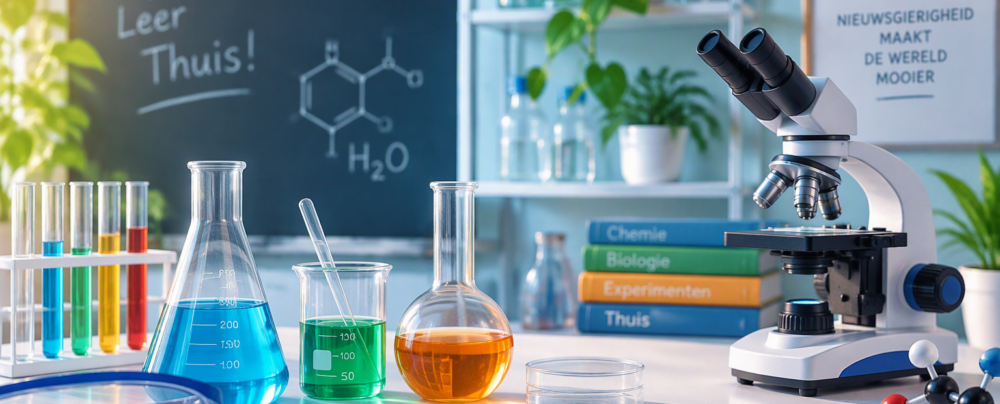
The Science Behind Home Experimentation
Science is fundamentally an experimental discipline. From the earliest natural philosophers to modern researchers, scientific progress has been driven by observation, measurement, hypothesis testing, and the systematic analysis of results. Many of the fundamental principles of chemistry, physics, and biology can be demonstrated using relatively simple equipment and materials, making experimentation accessible outside professional laboratories.
The website ThuisExperimenteren.nl focuses on this educational approach by presenting practical experiments covering a wide range of scientific disciplines, including chemistry, physics, biology, microscopy, electronics, optics, crystallography, and environmental science. The collection demonstrates that scientific inquiry is not limited to universities or research institutions but can also take place in a home laboratory setting.
Home experimentation provides a valuable bridge between theoretical knowledge and practical understanding. While textbooks describe scientific laws and models, experiments allow these concepts to be observed directly. For example, crystal growth illustrates molecular organization, optical experiments reveal the behavior of light, and electronic projects demonstrate the principles of electricity and electromagnetism. Through hands-on investigation, abstract concepts become measurable and tangible.
A key element of scientific experimentation is the scientific method. This process typically involves formulating a question, developing a hypothesis, designing an experiment, collecting data, analyzing results, and drawing conclusions. Repetition and critical evaluation help ensure that observations are reliable and reproducible. By following these principles, even simple home experiments can foster genuine scientific thinking and problem-solving skills.
Modern home laboratories benefit from affordable technologies such as microcontrollers, digital sensors, microscopes, data acquisition systems, and computer-based analysis tools. These technologies enable enthusiasts to investigate phenomena with a level of precision that was once available only in professional laboratories. The integration of digital measurement techniques also promotes quantitative analysis, an essential aspect of contemporary science.
Safety remains a fundamental requirement in all scientific activities. Responsible experimentation includes understanding the properties of materials, using appropriate protective equipment, maintaining good laboratory practices, and evaluating potential risks before conducting an experiment. Safe procedures not only protect the experimenter but also reflect the professional standards of scientific research.
Ultimately, home experimentation encourages curiosity, creativity, and critical thinking. It transforms science from a collection of facts into an active process of discovery. By exploring natural phenomena through observation and experimentation, individuals gain a deeper appreciation for the scientific principles that govern the world around them and develop the skills that form the foundation of scientific literacy.